Rainlamps Reimagined
Tee Shirt 1903 Wright Flier
Tee Shirt 1903 Wright Flier
Couldn't load pickup availability
Adult Tee Shirt - Black or White Option
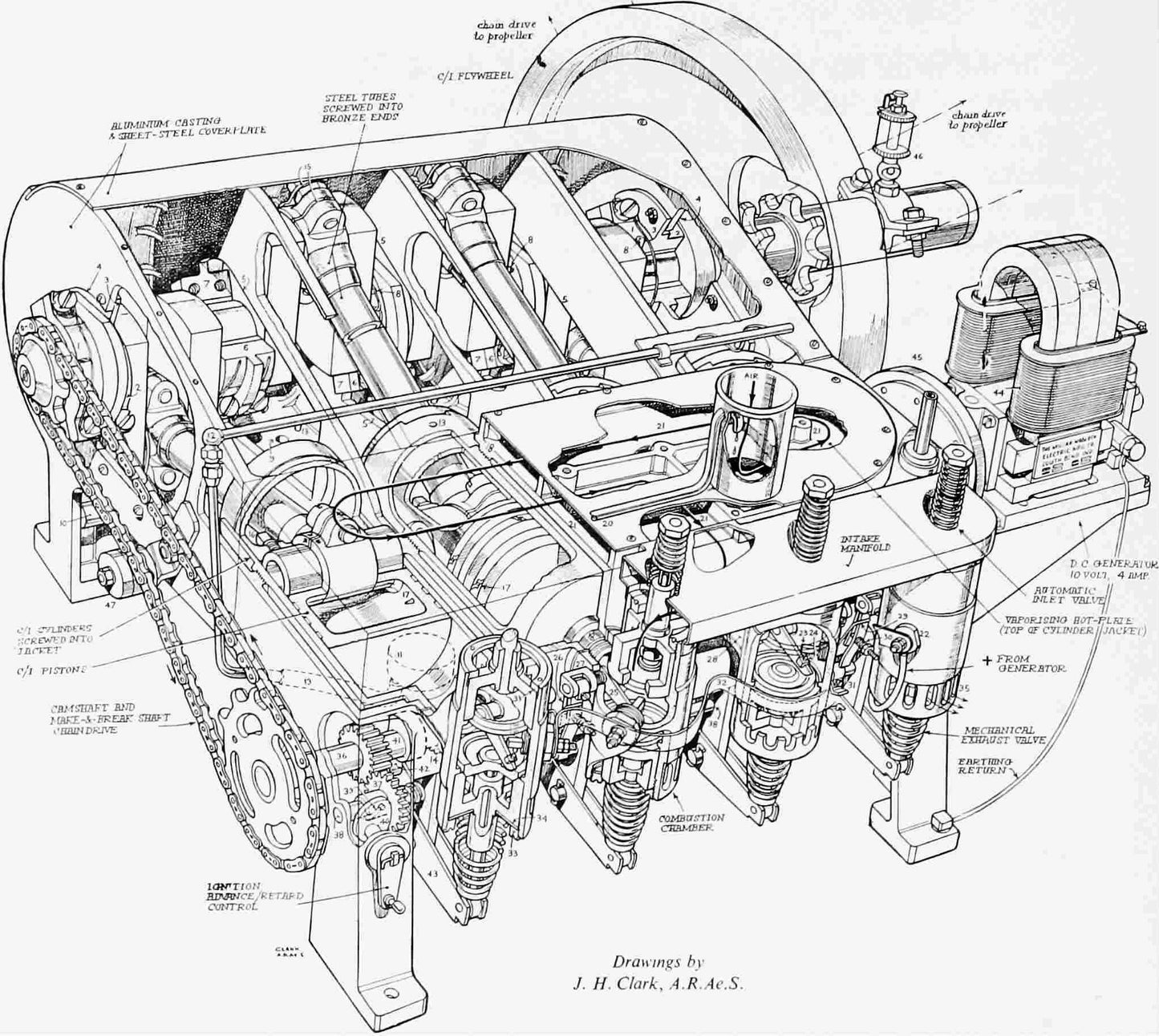
The Wright engine was of square bore/stroke proportions, unusual for the time, with a bore and stroke of four inches, yielding a displacement of 201 cubic inches. The crankcase was an aluminum-copper alloy casting, produced by a local foundry, while the four pistons were iron and the crankshaft was whittled from a thick steel slab by Charlie Taylor. He roughed out the shape with a hacksaw and chisels, and then finished the journals on a lathe. There were no formal drawings or plans as Taylor worked only from the Wrights’ rough sketches. The drawing above was produced decades after the fact by famed aircraft illustrator J.H. Clark.
The combustion chambers were an intriguing modular design that attached to the top of the cylinders. Each of these cartridge-like chambers contained a make-and-break spark igniter, an atmospherically operated intake valve, and a cam-actuated exhaust valve. A bicycle chain and a pair of sprockets operated the camshaft and low-tension magneto. The simple, raw-boned design did manage to keep the weight down to just 179 lbs, well below target.
The Wright Flyer engine actually produced—estimates range from 12 hp to more than 30 hp. This much has been established: On December 17, 1903, near Kitty Hawk, North Carolina, the Wright Flyer made four flights, traveling 120, 175, 200, and finally 852 feet. The fourth and final journey that day lasted 59 seconds, and the era of manned, heavier-than-air flight had begun. If you had to pick just one single internal combustion engine as the most important in history, the task might be nearly impossible—but this one would make a fairly respectable candidate.
The primitive fuel-supply system employed no throttle and the engine ran at constant max rpm, approximately 1020-1090 rpm, turning a pair of pusher propellers. Hand-carved by Wilbur Wright, each propeller was 102 inches (8.5 feet!) in length, and the entire assembly was devised to produce somewhere in the neighborhood of 90 lbs of thrust.